This batch is really special and it’s a read but I beg of you to sit down and digest it. We headed to Oaxaca in January to seek out new agave batches – and more, as you’ve now seen – and one of our stops was to be with Lalo Perez in El Nanche.
The road to El Nanche wasn’t too bad – only a couple hours from Oaxaca de Juarez where we were staying. We’d end up stopping along the way – I can’t recall. We pulled off the main road for a favorite of Carlos and we got settled for a quick, albeit fantastic, breakfast.

There were enough of us to just about try one of everything. And it was all fantastic. Full and ready for the day, we headed on south to where we’d be tasting for the day and to meet Lalo Perez in El Nanche.

in El Nanche, Lalo Perez lives with his wife and his children. They were mid-construction on their new home and they were kind enough to host us there. Lalo had learned from his father ‘Tio’ Tello and we’d get to meet him later in the day. We were there to hear from Lalo, learn about his preferred production methodologies and also to taste some batches for the program. It was going to be a great day.

The view from his home was enviable. Visibility, like much of the area, was obstructed only by brush and agaves and he had lovely views of the mountains far out. They had built a cozy covered patio and we pulled up some chairs and got comfortable.

We got comfortable once we saw what was on the table for tasting. More accurately, what wasn’t on the table for tasting! Thankfully we had brought plenty of water and we’d be having lunch with them as well. So, there was really no reason not to get tasting. Veladora’s up!

In spirits, it’s not uncommon to be very picky about glassware. I get it, and I have my preferences when I’m in a lab or my home and the goal is to hone in on everything. In mezcal, the veladora (a fancy shot glass that also holds a candle nicely if you’re religious) is the vessel of choice. And as it were, in Oaxaca, it was my vessel of choice.

We poured and we listened to Lalo for several hours. He had so many fantastic batches, some we purchased for ourselves (because they were tiny – just a few liters) and others for the group as there was enough to go around. He enjoyed some tasteful infusions as well – fruitas (6 fruits), marijuana, strawberries, citrus etc. Some were too good not to bring a liter home from. Maybe I’ll pour some at an event in the future.

There were some batches we couldn’t say no to. One was a wild tepextate that was the star of the day. Lalo would go on to let us know that his father distilled it. He doesn’t distill much anymore because he’s 77. But, the batch stood out and remained a memorable icon of the day. It was Tio’s Tepextate.

I sipped and watched their newest palenque pup bask in the attention of both new guests and the curiosities of the countryside and knew we’d need to buy the batch.

Their palenque – where distilling and the entire fermentation/distillation process occurs – was just a short mile or so away. We hopped in the trucks and made our way over. There is a simplicity to most palenque’s and the Perez’ palenque showed a lot of that as well. It amazes me that experience, strong agriculture, and the right tools can make such incredible distillate. It doesn’t have to be fancy – it just needs to work, and the hand of the maker needs to work it.


Lalo showed us both their roasting pits (also known as an oven) as well as the core pieces of the Palenque. They were not producing that day so it was a manageable temperature and they walked us through their process which includes wooden mallet to soften and break up the agaves once cooked.

Carlos from our crew, partner and a big piece of 5 Sentidos, showed us a couple interesting points on the mallet. Notice they aren’t centered like a hammer or a modern sledge – instead very oblong for a more aggressive mashing stroke. Also, they’re heavy as shit.

Just outside the doors to the palenques rows of agaves were growing. It was incredible, company, and reminds me how every producer works with what they have and builds their palenques in the ways in which they prefer. Lalo had some final batches fermenting and it was so neat to dip in and see what was rolling.

If you’ve been to a distillery in the US, you have seen stainless tanks of all sizes for fermenting. In Mexico, it’s very different. These are cypress vats and they will see both dry and wet fermentation of the pinas to produce agave distilaltes.
The real treat though was the quiet shuffle of someone coming to join us just as we got to pouring some new things.

Tio Tello, Lalo’s father, had heard we were swinging by and he wasn’t one to miss out on a good chat. He’s nearing his 77th birthday and did not let that stop him. A gentle, concise, speaker – he had a lot to say but managed to say it with few words. He told us all about raising a family, and his youngest – Lalo – who we’d been spending the day with. About how he prefers to make mezcals and his preferred varietals.

Eleuterio “Tío Tello” Perez Ramos, born in 1949,
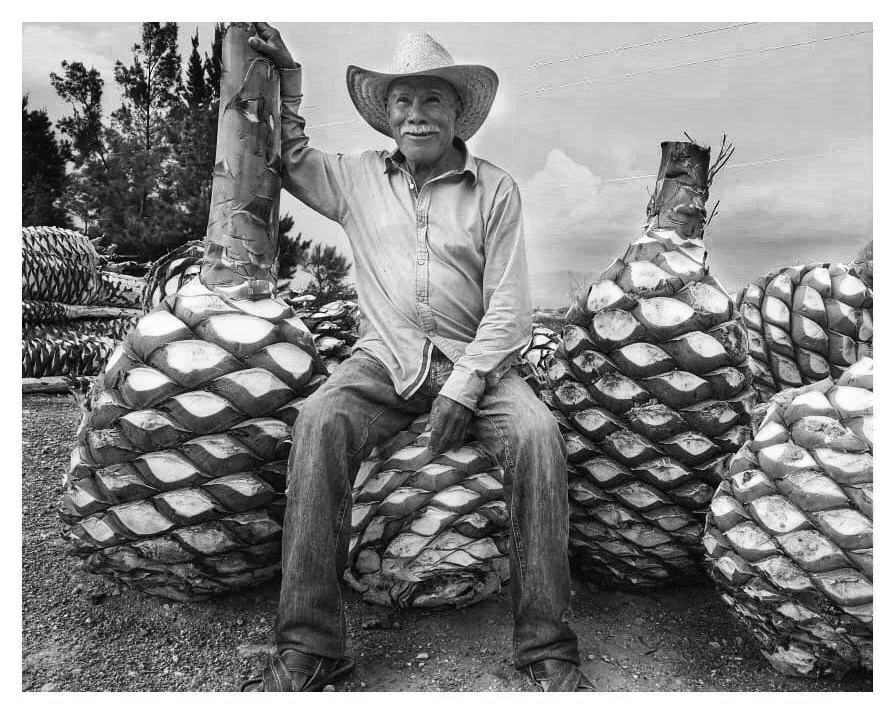
image credit, and text below, 5 Sentidos
Eleuterio “Tío Tello” Perez Ramos, born in 1949, is a second-generation mezcal producer on his father’s side and at least a fourth-generation producer on his mother’s side, which is believed to have been distilling mezcal in El Nanche, Oaxaca, since at least the mid-1850s.
Tio Tello’s mezcales demonstrate his demanding standards for the use of ripe “quiotudo” agave, and he employs unique distillation cuts that expertly balance the acidity of “xixe” (tails) with bold roasted agave of the hearts. Nowadays, Tío Tello’s youngest son Eduardo “Lalo” Perez Cortés does the majority of the work, distilling batches from his father’s agave for his father and his own agave for his own batches, which tend to be proofed slightly higher.
Friends, family and neighbors meet at Tío Tello’s palenque to assist with mashing after the roasting is completed. This leads to a social ritual experience between them that develops a strong sense of community and support. He also believes that mechanical shredding could impart undesired flavors so he prefers chopping the cooked agave with a machete and mashing it with large wooden hammers. Tío Tello’s palenque is undoubtedly one of the last palenques in Miahuatlan that still employs the manual crushing of cooked agaves with wooden mallets.
Although his palenque is remarkably quaint (with just three fermenting tanks and one copper still), there is nothing rustic about the refined flavors of his spirits.Tio Tello has over five decades of experience distilling mezcal. He and Lalo work mostly with Espadin, Cuishe and Madrecuixe and occassionally use wild agave varieties for smaller batches.
The Batch
my words, images

It is a treat to hear from any producer, on their property and in their words, but it was especially meaningful to hear from two generations of destillado producers that day. And it cemented in my mind that the Tio Tepeztate was the batch to kick off with.
This batch was produced from his final roast of summer 2024, just days before our visit, and it is a special one, bearing Tio Tello’s name and the handiwork of both father and son. They wished to keep some for themselves and we said, of course. 168 bottles came stateside for our group.
- Distilled: Oaxaca, Mexico (Tio Tello)
- Bottled: Oaxaca, Mexico (5 Sentidos)
- Agaves: 100% Tepextate
- Cooking: 7 Day Cook
- Fermentation: Dry Ferment (2 Days); Wet Ferment (7 Days)
- Water Source: Well Water
- Distillation: Double distilled, Copper Alambique
- Distillation Location: El Nanche
- ABV: 47.4% ABV (proofed witth heads and tails)
- Yield: 168 Bottles, 156 for available for sale
- Price: $139.99
- T8ke’s Tasting Notes: Vibrant, hearty, rich on the nose: vanilla and citrus candies meets a rich sweetness of rock candy, slate and minerality. Juicy bell pepper pops and there’s no shortage of minerality, a hint of pepper, and more citrus candy. The palate is bright, less pepper-y here and more sweet, fruit forward. Jelly beans, lemon tart, flan and a touch of jalapeno pops in with more pepper. The finish is driven: mineral, sweet, citrus and more ripe bell pepper with hints of saline, white pepper, orange peel and lime tart. Icing and rock candy leave a pleasant, sweet, decadent hand of flavors behind. Less vegetal than most recent Teps I’ve had bottled, but somehow as bright, and vibrant, and powerful and complex as any.
- About The Batch (Back Label Text – Sentidos): In the summer of 2024, right on the cusp of rainy season, Eleuterio “Tío Tello” Pérez Ramos of El Nanche, Oaxaca, carried out his last agave roast of the dry season, and in it, he included about four tons of wild Tepextate (a. Marmorata) that were purchased from the village of Palmar. He roasted the agave with mesquite for a week, then proceeded to process the cooked Tepextate as he normally would: having friends and family help crush the cooked agaves with wooden mallets and machetes, eventually dry-fermenting the mash in sabino cypress tanks for two days, before adding well water and allowing fermentation to continue for another seven days. Once he deemed fermentation to be complete, his son Lalo double-distilled the mash in two 300-liter copper pot alembic stills. Tío Tello then proofed the resulting spirit with heads, hearts and tails to create a spirit that fit his tastes. The result was about 180 liters of this Tepextate. Distilled in June 2024. 126 liters of this batch were selected by and bottled for our friend T8KE
After the selection, we had a phenomenal meal of tlayudas and chapulias with Lalo and his family. Our faithful palenque pup companion deemed it naptime and we agreed and hit the road back to Oaxaca for a long evening drive.
Enjoy some more pictures from the day, and just the start, from our journey.


